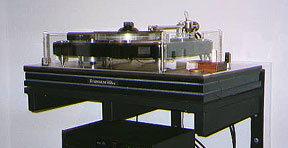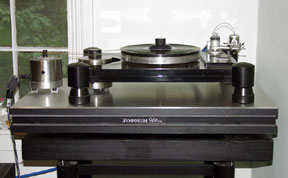
Click to enlarge image
Mechanical energy- the analog domain
The energy distribution in an analog turntable is of primary interest if a phono stylus is to transcribe records accurately. In order for perfect playback to occur, the stylus must be perfectly aligned and oriented to the record groove, and one other thing: absolutely motionless with regard to its reference position. Intefering with this theoretical perfection is the reality that mechanical vibration, like waves distorting the surface of a calm body of water, is busy at work not only pushing the stylus around, but is also deforming and distorting the groove walls and tone arm, changing their relative shape and alignment to the stylus.
Of course, these changes are extremely subtle, on the order of microns (millionths of an inch), but since groove modulations can be even smaller than this, they become significant. As recently as 20 years ago, the role of subtle extraneous vibration and its deleterious effects upon analog playback were widely unknown, if ignored altogether beyond the token "spring" suspension to keep a stylus from skipping out of the record groove (caused by gross displacement of the turntable chassis). In the late 70's, a certain audio reviewer noted a "phenomenon" whereby if a turntable was supported on a "cheap,"wobbly table, it sounded better than if on a "sturdy" one. At the time, the reviewer could not explain the reason for this phenomenon. The reason why the wobbly table "sounded" better is clear now: it acted as a crude isolation device, decoupling the turntable from floor-borne vibration.
Enter Isolation
You can think of the analog record groove/stylus interface as a kind of 3 dimensional sculpture in motion; as vibration is introduced not only to the groove but also to the pickup mechanism, this "sculpture" changes its form, with the result that the electrical signal faithfully follows these changes and sends a distorted signal to be amplified and later transduced into sound. In an attempt to avert this inevitable catastrophe, "isolation" platforms have been developed which attempt to "cut off" the turntable from the outside world, in an attempt to save the stylus/groove interface from the horrors described above. While some may be aware that perfect isolation is impossible at our present stage of technology, far more fail to realize that it is also undesirable.
Why Not Pure Isolation?
While it is intuitively obvious that the record groove itself should be free of extraneous vibration, what is not so obvious is the many ways that vibration can be introduced to the turntable in ways other than through its support surface. First and perhaps most obvious is airborne vibration: sound waves which travel through the air. Further, there are other sources, not so obvious, and these are generated by the turntable itself. The motor, belts, bearings, and most significantly, the phono stylus (as it vibrates in the record groove) contribute significantly to the circulating energy in a turntable/arm system, and it is vitally important to provide a place for this vibration to go - and not come back to your cartridge stylus.Until perfect, frictionless motors, belts, gears and bearings are developed, the only way to deal with the by-products of friction is to dissipate it. Most turntables make no attempt to absorb this energy internally except by serendipity: the construction materials used may combine in fortuitous ways to dissipate energy, but ultimately, there will always be some energy left over. This energy will circulate through the chassis of the turntable, and if it doesn't find any escape into a greater ground, it will eventually reflect back to the cartridge, where it will be faithfully included in the signal being generated.
Those Rubber Feet
The feet of a turntable are the only solid pathways to the greater ground that circulating energy seeks; but more times than not, this energy, trying to escape from the turntable, encounters a dead end: rubber feet. In the attempt to "isolate" the turntable from its surroundings, rubber or sorbothane is often employed in the form of "feet," or available as separate "isolators." Sorbothane and rubber solutions are popular and common; it seems to be an inexpensive solution which is intuitively obvious. However, there are specific reasons why Symposium does not and will not employ sorbothane rubber or similar, flexible polymer materials in any of its products. Sorbothane has very uneven characteristics as an energy conductor. While its compliance or softness acts like a "spring" at low frequencies and can be used as an extremely low frequency isolator, it is this characteristic that disables sorbothane from conducting energy to ground - which we have found to be essential for best results. Sorbothane conducts energy at some frequencies, absorbs at others, and stores and releases energy at other frequencies. In other words, a rubber or sorbothane foot acts as a kind of passive equalizer/phase shifter- with a "frequency response" that is far from the ideal, or "flat." Also, because rubber has non-linear storage and release characteristics, it does more damage than merely upset music's timbral color; it interferes with and distorts the vitally important time information by introducing complex, spurious group-delay characteristics back into your system.
Extremely Low Frequency Isolation VS Mechanical Grounding
Now we come to a seminal issue in the field of practical vibration control: Do you need isolation at low frequencies? If you walk across the floor while your turntable is playing and the stylus jumps out of the groove or the woofers go crazy, you've got extremely low frequency footfall issues. This is a completely separate issue from the resonance control supplied by the Ultra Platform. While the Ultra Platform does provide isolation over most of the audible range, it has been purposely designed to conduct energy at lower and lower frequencies. This means that if you have severe low frequency feedback or footfall issues, you should decouple the Ultra Platform from the source of these problems with a specifically designed low frequency isolator. One solution which will completely avoid the source of these problems is a wall-mount system that fastens into the vertical studs of the wall; please call Symposium for more information on wall mount systems for the Ultra Platform. However, if you can't do this, and the analog system must be supported by the floor (which is the source of these problems, since floors can "bounce" in similar fashion to a trampoline), you may wish to consider deploying Rollerblock Jr. beneath the Ultra Platform for lateral isolation, or a Compound-Isolated Isis Rack or stand for true isolation from severe low frequency problems.
A Few Words About "Compound Isolation"
"Compound Isolation" is a term Symposium uses to describe the basic isolation concept of the Symposium Isis Rack. (This concept and function is protected by a United States Patent.) Simply put, compound isolation occurs when Rollerblock isolation systems are put in series - which means that each isolation device multiplies or compounds the effectiveness of the next series-connected isolation system. In the Isis Rack, this is realized by multiple Rollerblock Modules which are placed in the leg system, which literally divides the Isis Rack into separate sections, each of which are isolated not only from, but also through the next section. It's possible to mimic this concept with multiple sets of Rollerblock Jr. and an Ultra Platform, by placing a set of Rollerblock Jr. between the turntable and the Ultra Platform, and then an additional set BELOW the Ultra Platform. This will increase the Rollerblock's ability to convert vertical waves to lateral waves, and the more "layers" of alternating Rollerblocks, the greater the Compound Isolation and the more effective the isolation from low frequency vibration.
Click to enlarge image
Why Our Platforms Don't Bounce
The Ultra Platform is not designed to correct extreme low frequency footfall problems - it IS designed to enable your analog turntable to elicit the most lifelike, musical sound possible from the record grooves, when installed as recommended. It does this by draining vibrations from the turntable and also from the support over most of the audible range without introducing new distortions or resonances. Low frequency isolation supports which employ rubber, sorbothane, or air bags (which are basically rubber tires) store and release energy back into the turntable. Unless carefully placed an octave or more below the lowest frequency of interest (which for turntables will be less than 1 or 2 Hz, because of the arm-cartridge resonance point), this "bounce" will usually have a resonance somewhere in the low to midbass range. This can at first sound like the system now has more bass, because extra energy has been converted to this region by the rubber foot system. Literally, vibration has been "redistributed" over a broad spectrum which is, more times than not, squarely in the midbass region. Many people appreciate at first blush the "warm" tone that this class of device imparts to the sound; however, this is extraneous distortion, and has nothing to do with the original signal. Worse, by adding extraneous energy back to the signal, time delay distortion occurs, "blurring" critical details. In this way, a "reactive" mechanical device has taken one problem, the low frequency vibration, and traded it for another problem. While it's true that this may be the lesser of two evils, we try to solve the problem without such a compromise by suggesting low frequency isolation without resorting to these materials.Eventually, these types of "isolating" components can become fatiguing, because they obscure musical information and make hearing more difficult and listening a task rather than a mode of relaxation. Worse, they can skew the sonic cast of the entire system in the wrong direction- which can result in other devices, just as wrong, being used to "counterbalance" them. Ultimately, the entire system can become a "balancing act," where the loss or change of just one item can make the entire system unlistenable. The only way to cure this problem is to start over from scratch, and rebuild the system piece by piece.
Providing the Ideal Mechanical Ground
An Ultra platform, used with hard feet or metal points with a turntable, will give the energy in the turntable a place to go, be dissipated, and not reflect back. "Softer" or "light" shelves can't provide the proper impedance matching, and are just scrambling vibration into different patterns- and not getting rid of it. Glass, stone, and undamped metals are unable to dissipate energy; most of it will simply reflect back into the turntable, creating "micro echoes" of the signal, further distorting it. To summarize, then, the best way to get rid of vibration is to either give it a place to go, or change it into a different form. The Ultra does both.
A Specific Example with the VPI TNT + Flywheel
Click on the banner below for pictures and a discussion of one such installation of the Ultra Platform with a VPI TNT+ turntable.