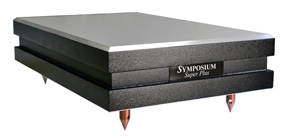
There has been some talk of late about "Chassis Damping" plates and platforms as if this were something new. Actually, chassis damping is just another term that describes what has been the essential function of Symposium platforms since their introduction in 1994! The original concept of the Symposium platform wasn't just to isolate a component from whatever it was sitting upon, but rather to go a bit further, and reduce the internal vibration that plagues all audio components because of their physicality without creating new problems in the process. To this purpose, Symposium was granted a patent for the stepped mechanical impedance scheme used in the Super Plus, Ultra, and Segue platforms, and the realization of this technique requires intimate coupling between the Symposium platform and the equipment chassis. Whether you call it "Energy Drainage," "Resonance Damping" or "Mechanical Chassis Damping," it is the same thing - and, yes, we invented it, officially, as certified by a United States Patent. But we'll discuss it in active terms that describe the process of mechanical energy flow that enables chassis damping to occur - energy drainage out of the component, into a dissipative mechanical ground. Whether the platform is directly contacting the chassis, with no coupling device in between, or whether it uses a coupler device (that is, a Coupler, point, or cone, etc) to make this connection, it's doing the same thing- damping the chassis, and by extension, the entire component. That was Symposium's original concept for an audio platform, and the principle is as valid today as it was then - or will be in a thousand years.
It should also be noted here that chassis damping of the TOPS of components is something Symposium platforms have been doing well for years and years - mostly by the Svelte Shelf or Svelte Plus platforms, which are extremely effective placed on TOP of components. In fact, Symposium won a "Standout Room Award" from Soundstage! for a CES demonstration of smaller Svelte Shelves used to damp the tops of digital source components.
Energy Absorption Platforms - providing more than just Isolation
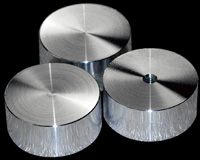
A major part of Symposium design philosophy is the importance of energy drainage from the component. We have found that, in the majority of cases, good energy drainage is more advantageous than pure isolation per se (please see the Technology section), and although isolation is an important part of their function, this is why we don't call our platforms isolation platforms, but rather "energy absorption platforms." In order to drain the component adequately, it is necessary that there be a good mechanically conductive pathway between the component's chassis and the shelf- which is what the couplers provide. Couplers are meant to contact the bare metal chassis of your component and bypass any rubber or soft feet which may be there, thus providing a more efficient evacuation of internal vibration out of the component. Soft rubber feet are meant more to protect furniture, but in practice, they tend to "blur" and distort the performance of most components. In fact, because rubber and sorbothane are a blockage to mechanical energy transmission, resonances which exist inside the component (and this is common) are actually intensified by their use. When a component has been "voiced" by the designer with certain inherent mechanical resonances, rubber feet will intensify these resonances and so may be favored by the designer - or the user, if the user likes those flavorings and colorations. However, the use of internal mechanical resonance to seriously affect the performance and character of a component is a questionable goal at best, and is known to deteriorate signal preservation. The purpose of our platforms is not to enhance resonances, which are caused by extraneous mechanical energy, but to get rid of them. There is no symbol for mechanical resonance in any electronic schematic diagram, and it doesn't belong in any properly designed, modern component.
When you effectively couple your component's chassis to the top of the Super Plus, the platform essentially becomes an "extension" of your equipment chassis, and damps it better, reducing spurious vibration more effectively while improving performance by reducing noise and intermodulation distortion in internal parts and circuitry. This is why we supply couplers with every Super Plus. While it isn't necessary to use them in all cases (for instance, if your component already has built-in metal feet without rubber pads on the bottom or built-in cones), we encourage their use if you don't have an alternate and appropriate ”footer" device, such as Symposium Rollerblocks, cones, or other hard footer devices, etc.
"the Super shelf was such a significant increase not only in clarity throughout the frequency spectrum (truly, a shock), there was surprising increase in *apparent* bass. It seemed to my ears to actually go lower. I can hear down to 32Hz and feel much lower, of course. The bass seemed to go maybe 6+ Hz lower, and this on the Shearwaters, which only go to 35 Hz"
-J. T., New Jersey
About Bass
This unsolicited note from a customer illustrates a very important point - that is, when bass overhang is eliminated, true bass is revealed, and this often includes bass fundamentals which were previously masked by transient smearing and other anomalies which can be caused by poor vibration treatment, such as those caused by rubber or polymer layers. Remove the rubber, replace it with a dissipative methodology that eliminates noise without distorting the signal, and suddenly you can hear what's "really" there, like an image suddenly snapping into focus after being blurred. Bass quality is profoundly affected by vibration in a key component- and it sometimes takes a bit of experimentation to determine just where the problem is originating. In the case cited in the quote above, the component used with the Super Plus platform was a preamplifier. The preamplifier is a very important, often vital part of most music systems, acting as the control center that also performs the initial signal processing and/or routing. This is critical, since ALL source signals travel through it and can be subject to damage by vibration.
In the case above, this particular preamp was quite susceptible to vibration effects, and before the Super Plus platform was installed, another type of "isolation" platform - an "isolation sink" that used a rubber air bag (actually, a small tire!) as a cushion to "ward off" vibration had been used. These types of "air bladder" tables are touted as an end-all for all isolation and vibration problems, since they purport to provide an "air cushion" of isolation. Unfortunately, it's not quite that simple. In such so-called "isolation" devices, the actual "isolator" is not air, but rather a stretched membrane of rubber that uses compressed air to keep it supported. Thus, the component is not riding on air - it is riding on the stretched rubber walls of an air bag or, in fact, a heavy duty balloon. When we ride on a tire, say, on a bicycle, and go over a bump, it is not the air that is providing the compliance that cushions our rear ends - it is the stretched rubber of the tire itself. (Air does not "like" to be compressed, and whenever air is forced to contract or expand, it creates unexpected problems which damage sonic characteristics - but more on that later) Rather than provide effective isolation or improve performance aspects, this air bag platform actually made the problem worse, because devices such as these (like rubber feet and rubber pods) store and release energy, distorting transient response and even affecting perceived frequency response by transposing energy from the time domain to the frequency domain. While stretched rubber devices such as air bag isolation platforms can give an initial "impression" of a warmer midrange and fuller bass, what these devices are really providing is time-smearing of information in this region - in other words, distortion.
Thus, it is not surprising that when this distortion-producing device was removed and replaced with a Super Plus platform, the result was a "shocking" revelation - as reported in the quote above. This is what we mean when we say that our isolation devices are not "reactive." An air bag system is a reactive system, because the system itself reacts and actually changes its characteristics as it responds to vibration - which means that, moment to moment, systems like this have a different resonant character, introducing very complex distortions to your music. Symposium devices are designed to be either conductive or resistive in nature - which means they behave in a more linear and predictable fashion (that is, they do not change their transmissive physical characteristics) while converting energy to heat or diverting energy to a greater ground where it can be absorbed. That means they remain more linear, and will not modify the original signal, which is what is desired in a sound reproduction system.
The Super Plus platform is a "quasi-solid" platform that is designed to dissipate excess vibratory energy as heat energy, and so it doesn't add additional resonances to the system- which is why the person quoted above was "shocked" by the improvements he heard in his system when he added a Super Plus platform under his preamplifier. Further, the isolation that the Super Plus provides is a resistive in nature - meaning that energy traveling through the platform is dissipated and simply converted from mechanical energy to heat energy, which is what a pure resistor is supposed to do, without creating new resonances, euphonic or otherwise. So, when the resonance that the airbag platform was creating was removed, his preamp was allowed to function more closely to its theoretical limits, and his system performance took a leap forward. The same kind of benefits are heard with all types of components, active and passive - preamps, amps, CD and SACD players, digital servers and storage devices, power conditioners, power supplies, loudspeakers, and more, because in all cases, the physics of what is happening and the benefits from addressing it is the same.
The Super Plus with Loudspeakers: Is the Tail Wagging the Dog?

This
|

...Not This!
|
Spot Quiz: What's the biggest source of vibration in your system (unless you're using headphones)? Answer: It's your speakers, of course, whose very job it is to MAKE vibration! This vibration is meant to be transferred 100% to the air, in order to make sound waves. However, there is no such thing as perfect efficiency, and most of the power put into a speaker is burned up as heat, and only a very small percentage is converted to sound (typically only 1% to 3% or less for direct radiator speakers, and 10% - 30% for horn drivers).
Not all of the vibration of the speaker drivers gets into the air - in fact, a good deal of the motion of the speaker diaphragm is transmitted to or "leaks" into the speaker cabinet. Because of this fact, every speaker, regardless of price or type, will have excess vibration flowing in its cabinet. This vibration, unless eliminated, shakes the cabinet walls (or box, or speaker frame), which supports the speaker's drivers, whether dynamic or electrostatic in nature. This vibration creates movement of the cabinet walls, and thus the walls are now moving the drivers as they themselves move. By modifying the movement of the driver diaphragms as they move the air to make sound, the result is intermodulation distortion and complex FM (frequency modulated) distortion of the otherwise theoretically "pure" signal being traced by the loudspeaker diaphragm. What's shaking the speaker drivers is literally their own echo, coming back through the cabinet, and in essence, what we have is an electromechanical case of the "tail wagging the dog."
Less Tail, More Dog
A Symposium platform placed beneath your loudspeaker (preferably in direct contact with it, with no spikes in between) will drain more energy from the cabinet than a set of points - at any price - or a dedicated speaker stand, since none of these possess the Super's dissipation engine. Simply put, any kind of footer (even our own) simply cannot compete with the Super's sheer "horsepower" in its ability to convert mechanical energy to heat energy. It's simply an unfair comparison.
Even the very best speakers, which may weigh hundreds of pounds and are made of extremely rigid, proprietary "high-tech" cabinet wall material, can not get rid of spurious vibration entirely. The Super Plus has been used with Avantgarde, B&W, Duntech, KEF, Magneplanar, Wilson, and virtually all of the world's finest "high-tech" loudspeakers with brilliant results. Improvements are much of the same character of the Svelte Speaker Sets, but with even greater effectiveness, owing to the Super Plus' patented design of mechanical impedance matching and its greater mass, all of which creates a unique ability to absorb more energy without unwanted "side effects." What you'll hear is more authoritative bass "punch" with less overhang and "mud," (see customer comments at top of page) a cleaner, purer, more musical midrange, and a more relaxed, yet faster top end that is so important for a convincing illusion of live music. Best results are usually realized without spikes (when platforms can be placed flat on hard floors without carpeting), and the 2.75" overall thickness of the Super Plus should be taken into consideration with loudspeakers that are sensitive with regard to tweeter height (if tweeter height is an issue, select the Svelte Shelf or Svelte Plus platforms.) NOTE: In cases with loudspeakers with dedicated bases or plinths, we recommend using the manufacturer's supplied spikes to make direct contact with the top of the platform, as these bases often provide part of the "voiced" sonic character of the loudspeaker. Placing the platform under such integrated bases and retaining the manufacturers' original spikes will maintain the plinth's resonant character, but with a greatly improved mechanical ground connection, providing enhanced performance with preservation of the original sonic cast.
Audiophiles, casual music lovers and recording studios alike use Super Platforms under their loudspeakers, with familiar reports of the owners being pleasantly "shocked" by the improvements - and all at a fraction of the cost of often overpriced footer points.
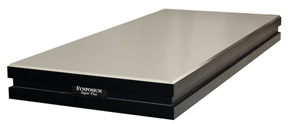
If you're serious about the quality of sound you experience in your music system, consider adding a pair of Super Plus platforms under your loudspeakers - by themselves, and installed as recommended, they'll unleash the full potential of the most critical link in your entire music system between an electrical signal and your ears.
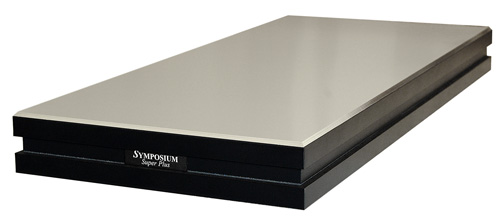
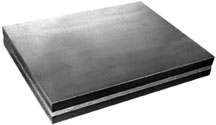 At left: Symposium's first product, the "board" that started it all (circa 1993)