P A N O R A M A
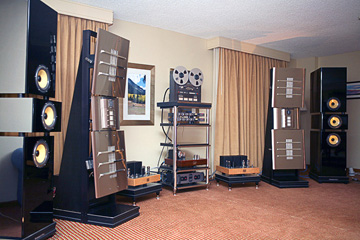
Winner of "BEST SOUND AT SHOW" both years it was exhibited at RMAF.
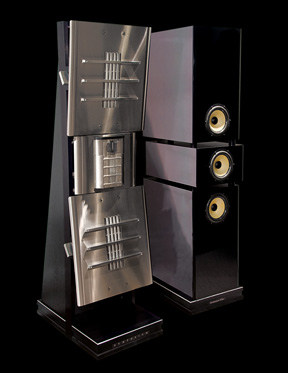

Winner of "BEST SOUND AT SHOW" both years it was exhibited at RMAF.
What? An isolation company making SPEAKERS?
Come on, now - that's what you were thinking, wasn't it? There's more to this story than meets the eye, and it will surprise many that the first product that Symposium originally planned to market was a full range planar loudspeaker named "The Symposium."
The first public demonstration of The Symposium loudspeaker was made in 1994 in Los Angeles (at a house owned by and rented from Hollywood cinematographer and director Jan de Bont). The Symposium was a bi-amplified, line-source system which included a full-range planar HF line source section and a separately powered, planar "ribbon bass" driver (see photo at bottom of page). This speaker was demonstrated to industry mavens which included the late, great reviewer Peter Mitchell, Stereophile publisher Larry Archibald, and audio-industry mover/shaker Peter Tribeman. All concurred that the speaker showed great promise and some even felt that it was a "breakthrough" in loudspeaker performance. However, a decision was made to pursue our isolation products first, and leave loudspeakers for later.
Deep Background
Contrary to what it might seem, loudspeaker design for Symposium was anything but an afterthought for Symposium's founder, Peter Bizlewicz, who had built and sold his first loudspeakers while still a university student in New York City to customers that included private individuals and recording studios. Years of experience building different types of loudspeaker drivers that ranged from electrostatic, plasma and ribbon drivers to transmission line woofers and bass horns paved the way for what was to follow.The Impetus
After exhibiting Symposium products for a number of years at CES, Rocky Mountain, Stereophile and other shows, we became discontent with the speakers available to us from other manufacturers which we used in our demonstration rooms. "Why not build our own?" we asked. Thus was the Panorama born.What It Is and What It Is Not
The Panorama is a four-way hybrid loudspeaker that combines proprietary ribbon and planar-magnetic drivers with a transmission line woofer. It is not a line source loudspeaker. It is not a dipole loudspeaker, but does combine both dipole and monopole drivers. Also, in its standard configuration, it is not biamplified, meaning that the woofer does not require a separate bass amplifier (although this is possible to implement if desired). The Panorama was purposely designed so that it could be used with just one amplifier per side; with an efficiency of approximately 92-93 dB, it can be driven to satisfying levels by as little as 30 watts per channel. And finally, the Panorama was designed and created to be one of the finest loudspeakers in the world, at any price.
The Planar Drivers
At the heart of the Panorama are its planar magnetic and ribbon drivers, designed and manufactured exclusively by Symposium, which benefit from proprietary technologies and materials. The drivers are constructed with no-compromise materials to achieve high rigidity, excellent mechanical grounding and low or zero chassis resonance. The Panorama planar and ribbon drivers combine extremely powerful neodymium iron boron magnet motors held by super-strong 7075 aircraft alloy aluminum bar and mounted on laser-cut, heavy duty articulated stainless steel frames. This very rigid and powerful dual-sided magnetic force field envelopes extremely low mass, specially suspended diaphragms. All told, the proprietary Panorama drivers, which operate between the frequencies from 80 Hz to beyond audibility, deliver unparalleled transparency and neutrality. The hallmarks most remarked about by listeners include their exemplary leading-edge transient preservation at all frequencies and effortless sense of openness, power and freedom that is at once relaxed and engaging. No cone, dome or horn drivers can match or even approach this performance; if they could, we would employ them in the Panorama.
Why not Bi-Amp?
The idea behind bi-amping is to allow a separate, dedicated amplifier (usually solid state) drive the woofer, and leave the owner to supply another amplifier to drive the rest of the speaker. Biamping is often employed when higher frequency horn drivers are mixed with direct radiator cone woofers, and also in all-direct radiator speakers in order to provide extended low frequency response by "forcing" the woofers to have extended extreme low frequency response through active equalization. Proponents of biamping cite its promise of greater bass "slam" and lower frequency response in a smaller enclosure size.In the quest for greater bass "slam," however, something more important is often lost in the process - the sense of coherency and naturalness that is the hallmark of real musical bass. Unless both amplifiers are exactly the same, they can never have the same overall character or sonic signature, and careful listening will always reveal this discontinuity, regardless of how carefully or perfectly the transition between drivers is made. Further, even if two identical amplifiers are used, there is still the active crossover network to consider, which will itself add coloration and additional sonic signatures to the mix. Compared to a passive crossover network, the insertion of an active crossover is much more audible. The experimental direct ancestors of the Panorama were originally biamplified systems; after weighing the pros and cons through first hand listening, we found that a passive, one-amplifier system gave a more satisfying, more unified musical experience.
Since only one amplifier is needed for the entire range and no active crossover network is required, the Panorama's character is completely coherent - "cut from the same cloth," if you will. There is no sense of "a tuxedo and brown shoes" or other aspects of mismatch between bass and the rest of the musical spectrum. Top to bottom coherency is essential for a transparent listening experience, and allows you to forget about one more technical aspect of sound reproduction. Still, if biamping is nonetheless desired, it can be accommodated through the Panorama's advanced crossover network with the flick of a switch - and another amplifier, of course.
The Bass System
The Panorama bass cabinets are twin, 13-foot (4m) long transmission lines. The woofer drivers, carefully chosen for their exemplary speed and extended low frequency response, are mounted to front panels of 5/8" (1.6cm) thick, precision machined 6061 "aircraft" aluminum, so that the front panels become an extension of the metal frames of the woofers, effectively stiffening their basket frames beyond what is possible with conventional enclosures. These aluminum panels are then bonded to a triple-laminated cabinet sub-wall of famous "Symposium" constrained layer laminate construction to form an enclosure of high strength, stiffness, and acoustic neutrality. Twin stacked bass enclosures are mounted on a dedicated "Stealth" Ultra Platform for absorption of spurious, internally generated mechanical energies and are effectively decoupled from returning floor-borne low frequency waves by Rollerblock® isolation. All of this just serves to make the woofers seem as if they were not there, because they blend seamlessly with the high frequency panels, providing authoritative bass that's nimble, detailed and powerful. Except for their stately physical presence, you won't know they are there, because, like the other drivers in the "Pannies," you won't hear the speakers - you will only hear the music!
Planar Driver Isolation through Symposium Vibration Control
Of course, a company that made its name on vibration control will employ such technology in its flagship loudspeaker. The Panorama's High Frequency towers also benefit from Symposium isolation and vibration control techniques, with an acoustically damped frame of massive 3" X 1" 6061 solid aircraft aluminum upright and cross supports.The anodized aircraft alloy frame uprights are terminated to a CNC (computer numerical control) fabricated, dedicated Stealth Edition Ultra Platform base, which is in turn Rollerblock isolated from the floor. The Ultra base absorbs and dissipates spurious energy from the drivers while providing additional isolation from floor-borne vibration sources. Rollerblock® isolation is used under the HF tower to reduce intermodulation distortion, and the UMD upper midrange planar and RT-2 ribbon tweeter are independently compound-isolated from the main frame of the HF section with a floating, damped spring suspension system. Due to the addition of isolation systems in series (as opposed to common parallel isolation systems), the extremely critical upper midrange and tweeter units benefit from Compound Isolation, patented by Symposium.
The Crossover Control Center
The crossover may be likened to the "brain" of any multi-way loudspeaker system, and orchestrates each element's contribution to the re-assemblage of the original signal. Crossover network design is as important as any other aspect of loudspeaker design: it doesn't matter how good the speaker drivers are if the crossover isn't correct. The Panorama Crossover is constructed with high quality silver wire, solid silver buss bar, premium silver/teflon capacitors and high quality resistors. Inductors in critical locations are premium 12 gauge copper foil units, while low-resistance, air core coils are employed for the low frequency filters. The inductors' magnetic fields are empirically determined and the coils are oriented for minimum field interaction with one another, a technique which can substantially reduce intermodulation distortion, and the entire crossover is built on a special Ultra Platform with no metal, so that the values of the inductors are not skewed. All components are measured by laboratory-grade instruments to verify unit-to-unit tolerances with regard to both value and Q while actually in operation. A 4-switch level control provides adjustable levels for all drivers to account for differences in room setup, recording variations, and personal preferences. The switches are of very high quality and employ silver coin-contacts for complete transparency while in circuit.
The Absolute Phase
Nearly every recording has a specific phase orientation - positive or negative - and one or the other orientation will provide audibly better performance. The Panorama crossover network includes a relay system with triple-redundant silver/gold contacts to give the user the ability to easily and instantly switch absolute phase from the listening position through wireless remote control. As opposed to active phase controls found on some preamps, DACs and other active components, the Panorama's phase control is completely passive, sonically transparent, and enables the listener to change phase with zero coloration, in order to provide the ultimate listening experience without compromise. Once you've used this feature and identified the phase characteristics of your favorite recordings, you may wonder how you ever got along without it.Press Reactions
The Panorama has earned extraordinarily positive reactions and attention from both audiophiles and press alike, including Stereophile, The Absolute Sound, and others. TAS's initial RMAF show report about the original Panorama protoype led to a coveted and unprecedented Golden Ear Award from senior reviewer Jonathan Valin. Mr. Valin's Golden Ear Award was the first ever awarded to a loudspeaker prototype. In addition, the Panorama was awarded the much coveted "Best Sound at Show" award two consecutive years in a row at the Rocky Mountain Audio Fest for both years the Panorama was exhibited there. We would like to thank Mr. Valin for his unwavering support of and enthusiasm for the Panorama, even in the face of opposition from Industry naysayers, competing manufacturers, and even his own magazine.
That Was Then, and This is Now
The Panorama has continued to evolve since Mr. Valin first discovered it. As the state of the art progressed and better parts became available, consonant and judicious refinements were applied to its speaker drivers and crossover network. This has resulted in a Panorama whose performance exceeds even that which set the audio world on its ear in the last decade. We invite you to audition it and see - and hear - for yourself.Pricing and Availability
The Panorama is available to private individuals or dealers with finishes to suit decor and personal preference. To arrange for a demonstration or for more information, please contact Symposium.
Above left, senior reviewer Jonathan Valin provides a photo op with the Panorama prototype. At right, the "Symposium," an experimental loudspeaker and direct ancestor of the Panorama, in a photo taken during its initial demonstration in Los Angeles in 1994. Click on the picture for further description.